 MoodSync
Year in Pixels, built for bipolar
- A full year of days on one screen, each colored by its 1–5 mood
- Fills itself from your entries — no pens, no catching up on missed weeks
- Long stretches and slow drifts read at a scale a month view cannot show
- Lives in Stats, next to your averages and correlations
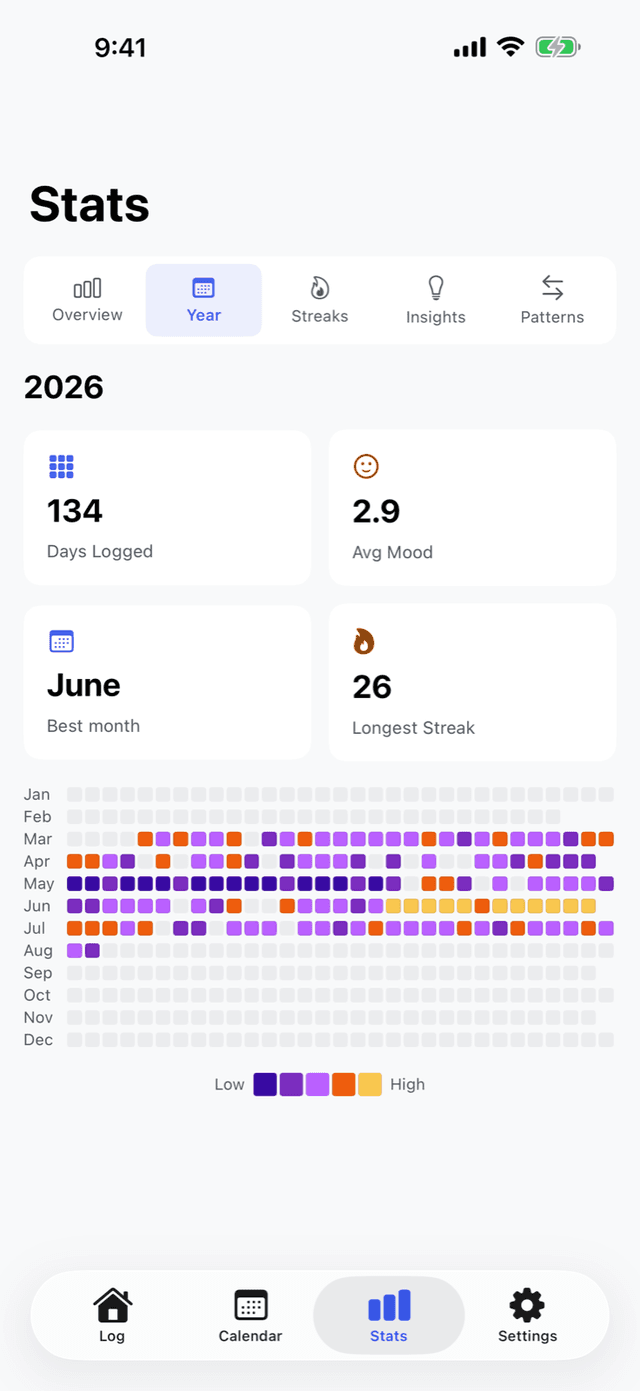
Year in Pixels started as a bullet-journal spread: one small square per day, colored by mood, 365 of them on a page. It works because a year is the right zoom level for mood. MoodSync draws the same grid for you, from entries you already logged.
The grid
Open Stats and Year in Pixels is there: every day of the year, each square colored by your 1–5 mood for that day. The same five colors as your calendar and the rest of the app — no new legend to learn. It fills itself. The paper version's known failure is the hole: miss three weeks in November and the spread has a gap forever. Here the squares appear because you logged, wherever you logged from.
Why a year, not a month
Mood episodes in bipolar disorder unfold over weeks and months. A stretch that builds slowly across six weeks barely registers inside any single month view; at the year level, the same stretch reads as a band of color with a shape and a length. That is a record to bring to an appointment, not a diagnosis — the grid shows what you logged and nothing more.
The zoomed-out view is also where context earns its keep. Sleep and circadian rhythm disruption are closely linked to the course of mood episodes in bipolar disorder2008, which is why the grid sits one tab from your sleep and meds correlations rather than off on its own.
The pixels only fill if you log
A year grid is only as honest as the days behind it. Ambulatory assessment rests on records captured in the moment, not reconstructed after the fact2013 — and the smartphone self-monitoring research in bipolar disorder runs over months of sustained use2015. That is what the one-tap Apple Watch app and the Home Screen widgets are for: making the next square cheap to earn.
Pro, plainly
Year in Pixels is part of MoodSync Pro — $4.99 a month or $29.99 a year. The download is free, and the core log, the calendar, and CSV export stay free. If you would rather color a paper spread, your free CSV export contains every mood you need to draw one.
Keep reading
Sources
- Trull TJ, Ebner-Priemer U (2013). Ambulatory assessment, Annual Review of Clinical Psychology. link
- Faurholt-Jepsen M, Frost M, Vinberg M, et al. (2015). Smartphone-based self-monitoring in bipolar disorder: an RCT, JAMA Psychiatry. link
- Harvey AG (2008). Sleep and circadian rhythms in bipolar disorder: seeking synchrony, harmony, and regulation, American Journal of Psychiatry. link