 MoodSync
Insights with research citations (Pro)
- 2-week mood trend, best/hardest day, sleep patterns, medication impact
- Prodrome warning when low sleep meets rising elevation
- Each card cites the paper it rests on — tap to open the source
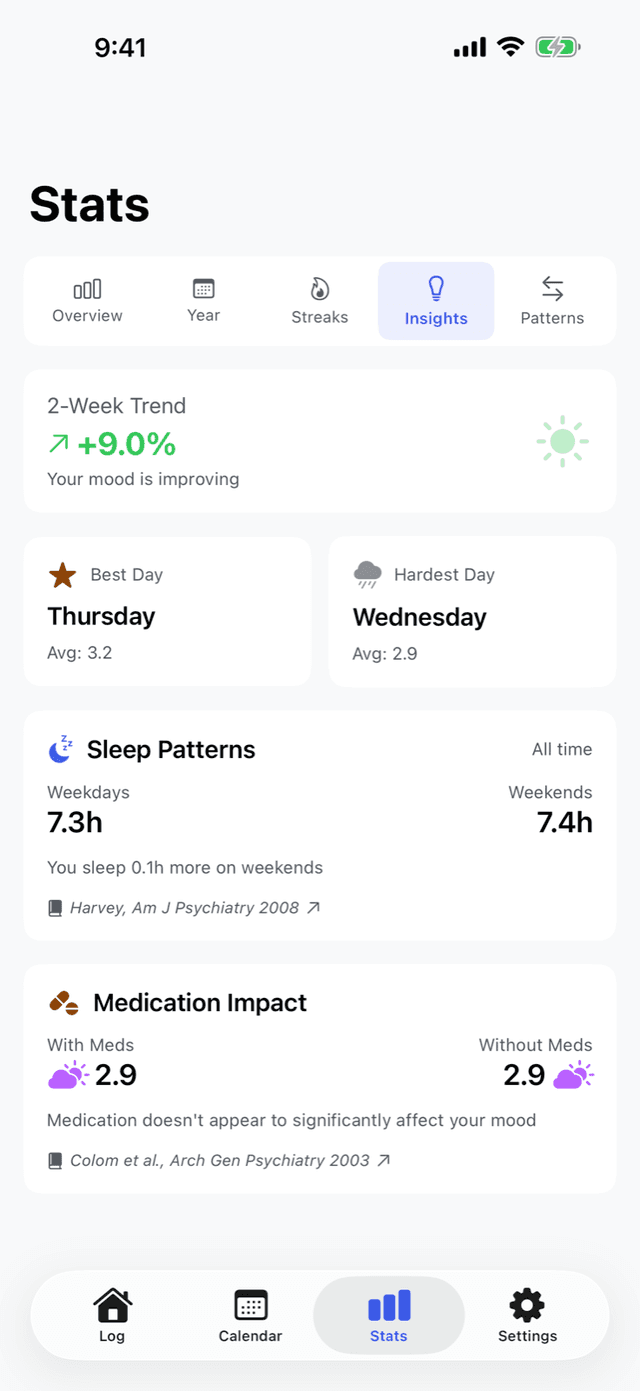
Most mood apps tell you what your data means. Few show their work. MoodSync's Insights tab does both.
The cards
In the Stats → Insights tab (Pro), MoodSync surfaces a small set of pattern cards from your own data:
- 2-week trend — is your mood moving up or down across the last fortnight?
- Best day / hardest day — which weekday averages best and worst for you
- Sleep patterns — your weekday vs weekend hours, side by side
- Medication impact — average mood on days you logged meds taken vs days you didn't
- Prodrome warning — flags when low sleep starts coinciding with rising elevation
What's behind each card
Each card carries a research citation you can tap to open the paper on PubMed. The cards lean on:
- Harvey 2008 — sleep–circadian coupling in bipolar disorder2008 for the sleep-pattern card
- Colom et al. 2003 — group psychoeducation and bipolar prophylaxis2003 for the medication-impact card
- Wehr et al. 1987 — sleep reduction as a final common pathway to mania1987 for the prodrome warning
Weekly reviews
Since version 2.0, MoodSync also writes you a short weekly review: a plain-language narrative of your last seven days — how your mood moved, how sleep tracked alongside it, what stood out. It is built on your device from a fixed set of rules, the same kind of logic behind the insight cards. No AI, no network call; your entries never leave your phone to produce it.
The citation approach carries over too. When a review points at a pattern — say, a run of short nights ahead of a rough stretch — it rests on the same published research the cards cite, not a black box.
See also
Sources
- Harvey AG (2008). Sleep and circadian rhythms in bipolar disorder: seeking synchrony, harmony, and regulation, American Journal of Psychiatry. link
- Colom F, Vieta E, Martinez-Aran A, et al. (2003). A randomized trial on the efficacy of group psychoeducation in the prophylaxis of recurrences in bipolar patients whose disease is in remission, Archives of General Psychiatry. link
- Wehr TA, Sack DA, Rosenthal NE (1987). Sleep reduction as a final common pathway in the genesis of mania, American Journal of Psychiatry. link