 MoodSync
Visit prep view
- Walk through your last month on your phone — mood, sleep, meds
- Tap any day for the full record (mood scales, sleep hours, meds, notes)
- A clinician PDF report to hand over — CSV export of the raw data stays free
The visit you have looked forward to all month is fifteen minutes long. Most of it gets eaten by "how have things been?" A diary in your head says "OK, I think." A diary on your phone says: this is what the last four weeks looked like.
What you bring
Open MoodSync. Hand over the calendar. Scroll back four weeks together — colored pills for each day, tap one for the full record (mood scales, sleep hours, meds toggle, notes).
If you have Pro, the Insights tab is the one-screen summary: 2-week trend, your best and hardest day, weekday-vs-weekend sleep, mood-with-meds vs without, and any prodrome warning. Each card cites the research behind it.
That is the prep. The chart is on your phone, the appointment is in front of you, and the conversation starts from a real month instead of a half-remembered one.
The clinician PDF report
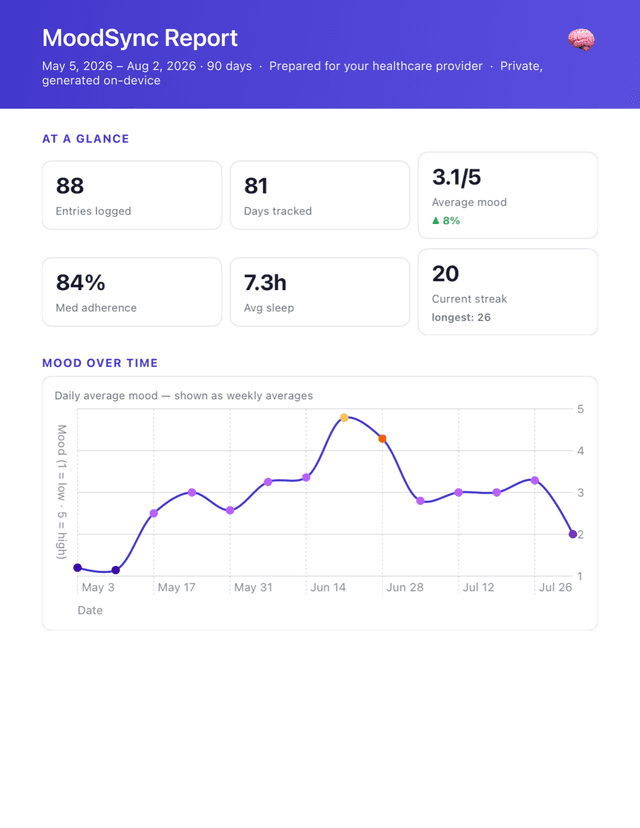
Handing your phone across the desk works. Since version 2.0, there is a better option: a clinician PDF report — a document built for the person reading it, not screenshots of your phone.
What your psychiatrist actually sees:
- Stat cards — the headline numbers for the period at a glance
- Mood timeline — the whole stretch of days as one continuous chart
- Sleep pattern — hours per night across the period
- Medication impact — mood on logged-meds days next to the rest
- Mood by weekday — which days of the week run high or low for you
- Clinical scales panel — the 0–3 depression, elevation, irritability, and anxiety scales over time
- Daily log table — every entry, day by day, for the clinician who wants the detail
And if your clinician prefers raw data over a report, CSV export stays free for everyone — one file from Settings, every entry included.
Why this works
Smartphone-based self-monitoring has been studied in randomized trials in bipolar disorder2015. Daily entries captured in the moment carry signal that retrospective recall loses2013. The trackers people stick with are the ones that take seconds — and the chart you scroll back through is what makes the visit specific.
What to read next
Sources
- Faurholt-Jepsen M, Frost M, Vinberg M, et al. (2015). Smartphone-based self-monitoring in bipolar disorder: an RCT, JAMA Psychiatry. link
- Trull TJ, Ebner-Priemer U (2013). Ambulatory assessment, Annual Review of Clinical Psychology. link
- Hamilton M (1960). A rating scale for depression, Journal of Neurology, Neurosurgery, and Psychiatry. link
- Young RC, Biggs JT, Ziegler VE, Meyer DA (1978). A rating scale for mania: reliability, validity and sensitivity, British Journal of Psychiatry. link