 MoodSync
Home & Lock Screen widgets
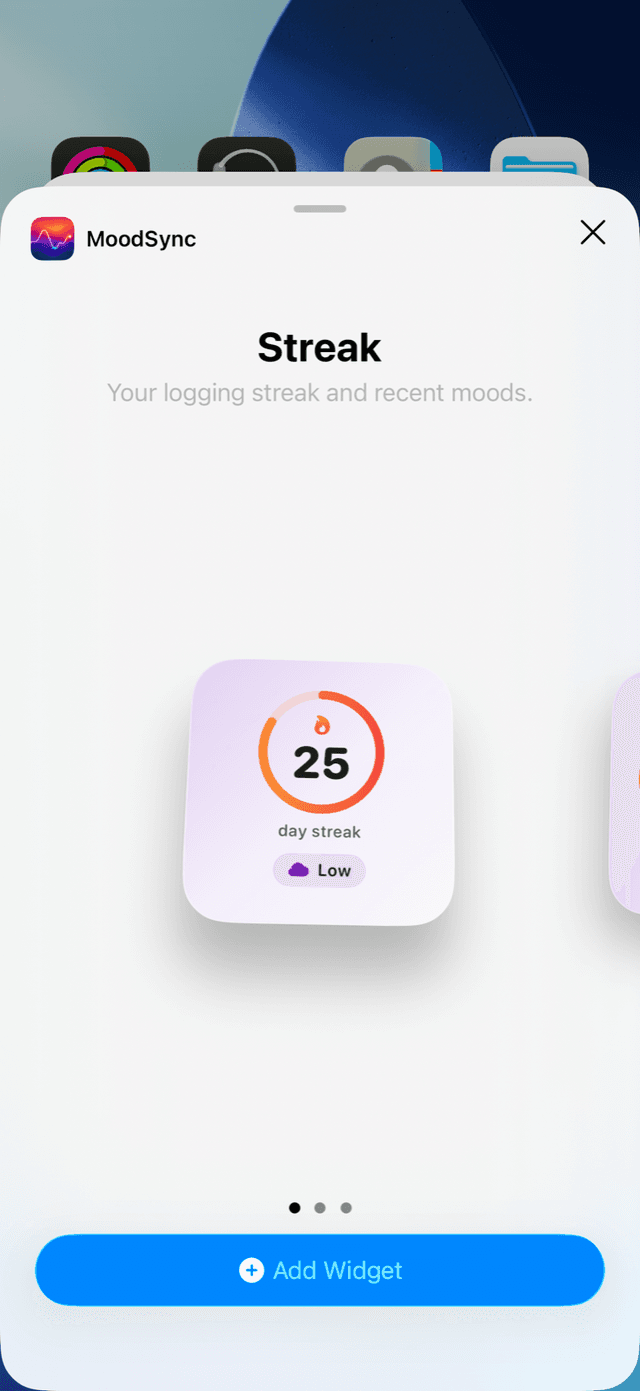
- Streak widget keeps your logging streak and recent moods in view
- Quick Log widget — tap a mood capsule and the entry starts
- Lock Screen circular and inline sizes, one raise of the phone away
- Every tap deep-links straight into logging, no navigating the app
A mood tracker you have to go looking for is a mood tracker you will quietly stop using. The apps that survive on a phone are the ones the phone keeps showing you. MoodSync's widgets put the streak and the log button on the screens you already look at all day.
Two widgets, two jobs
Streak shows your logging streak alongside your recent moods. It comes in small and medium for the Home Screen, plus circular and inline for the Lock Screen — the streak sits under the clock, one raise of the phone away.
Quick Log is a medium Home Screen widget with the five mood capsules laid out flat. Tap the one that fits and you are already logging — the tap deep-links straight into the entry, no app icon, no navigation.
Why visibility is the feature
Mood tracking pays off in months, not days. The smartphone self-monitoring research in bipolar disorder runs over months of daily use2015 — so the real design problem is not the log screen, it is week six, when the novelty is gone. A widget converts an intention into a thing your thumb passes twelve times a day.
The one-tap part matters too. Ambulatory assessment is built on capturing states in the moment rather than reconstructing them later2013, and every step between the moment and the entry is where reconstruction creeps in.
And the Lock Screen earns its slot at night. Sleep and circadian disruption are closely tied to mood episodes in bipolar disorder2008; a rough 1 a.m. is precisely when a tracker buried in a folder does not get opened.
Where the taps land
The streak in the widget is the same forgiving streak as the calendar — it counts days you logged this month, and does not reset over one missed Tuesday. Entries logged from a widget carry the full two-layer mood scale: 1–5 now, 0–3 clinical detail whenever you want it. On your wrist instead of your Home Screen? The Apple Watch app is the same idea, one screen closer.
Widgets read your data where it lives — on your device, with no account. Requires iOS 17 or later.
Worth a look
Sources
- Trull TJ, Ebner-Priemer U (2013). Ambulatory assessment, Annual Review of Clinical Psychology. link
- Faurholt-Jepsen M, Frost M, Vinberg M, et al. (2015). Smartphone-based self-monitoring in bipolar disorder: an RCT, JAMA Psychiatry. link
- Harvey AG (2008). Sleep and circadian rhythms in bipolar disorder: seeking synchrony, harmony, and regulation, American Journal of Psychiatry. link