 MoodSync
Calendar with forgiving streaks
- A month at a glance — every day shows a colored mood pill from your entries
- A streak that does not break on the day you missed
- Tap any day to see the full set of scales, sleep, and meds for that day
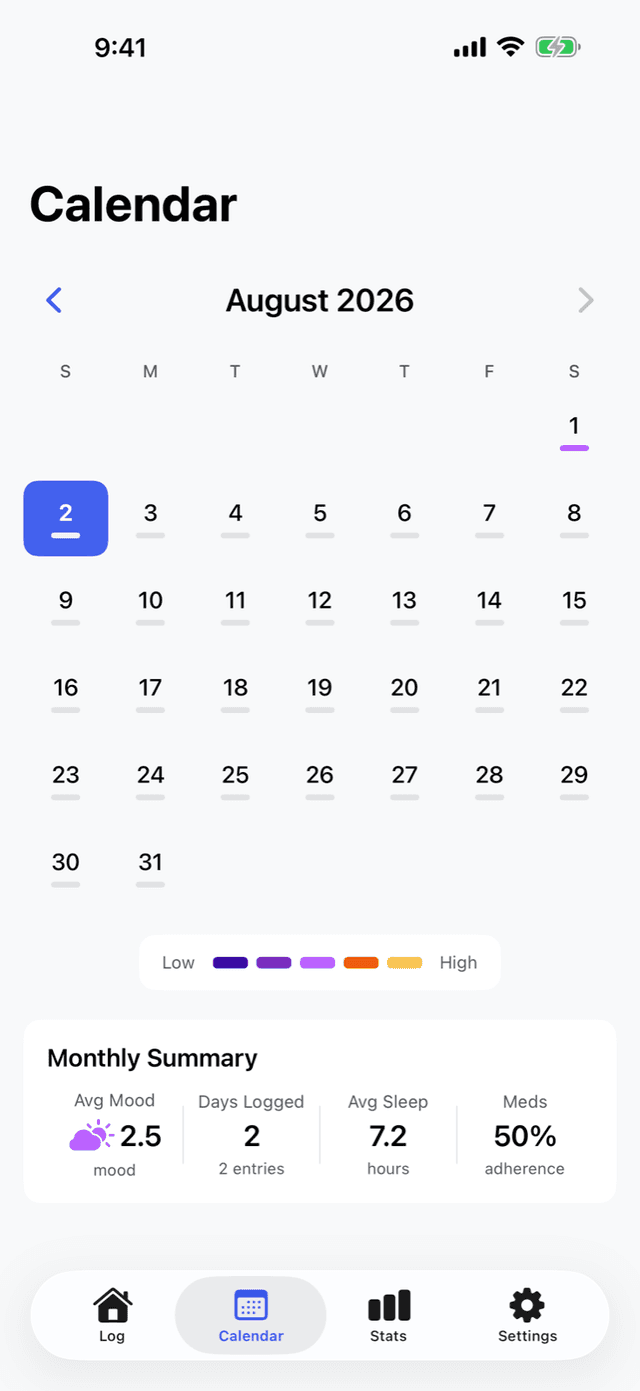
A streak that resets on a hard day is the wrong incentive in a mood tracker. The whole point is to log honestly. MoodSync uses a streak that counts the times you showed up, not the times you were perfect.
What the calendar shows
Each day shows a colored mood pill, with the color reflecting the average of your mood entries for that day. A run of green-ish days reads at a glance. A patch of red-ish days does too.
Tap a day, and the full record opens — every scale, the sleep hours, and which meds you took. The day-tap is the part that matters. Ambulatory assessment in psychiatry depends on entries that capture what was actually happening in the moment2013; the calendar is the way back to those entries.
When a month is too small a window, Year in Pixels compresses twelve months into a single grid — every day one colored square.
What "forgiving streaks" means
A traditional streak resets to zero the first day you miss. Smartphone monitoring works because it is sustainable for months2015 — the failure mode you are trying to prevent is a person quitting after one missed day.
In MoodSync the streak counts the days you logged this month, not consecutive days. Miss a Tuesday, log Wednesday, and Wednesday still counts toward your month.
Version 2.0 adds two more layers of forgiveness. A streak freeze silently covers a one-day gap — miss a single day and the streak carries on as if you hadn't, up to twice. And if a streak does break, streak recovery gives you a path to earn it back instead of starting over from zero. A bad day doesn't zero you out.
Why the calendar matters for visit prep
Clinical rating scales have long used short ordinal anchors to summarize a stretch of days1960. The MoodSync calendar borrows the same compact daily-snapshot idea (it is not a clinical instrument): a stretch of days you can scroll back through with your clinician, without trying to remember what last Wednesday felt like.
Worth a look
Sources
- Trull TJ, Ebner-Priemer U (2013). Ambulatory assessment, Annual Review of Clinical Psychology. link
- Faurholt-Jepsen M, Frost M, Vinberg M, et al. (2015). Smartphone-based self-monitoring in bipolar disorder: an RCT, JAMA Psychiatry. link
- Hamilton M (1960). A rating scale for depression, Journal of Neurology, Neurosurgery, and Psychiatry. link