 MoodSync
Sleep and meds, plotted next to mood
- Sleep hours and mood scales sit on the same chart, day by day
- A daily 'meds taken' toggle puts adherence next to the patterns it affects
- Spot prodromes weeks earlier by seeing sleep shift before mood does
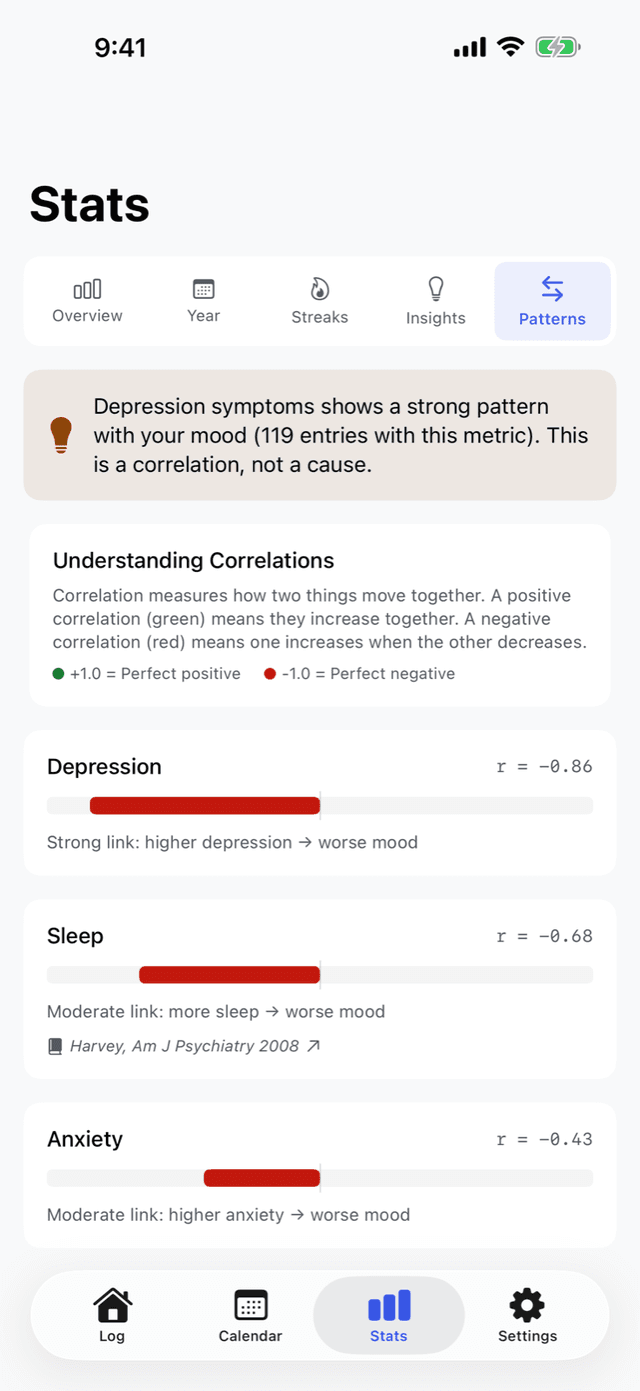
Most mood diaries treat sleep and medication as afterthoughts. For bipolar disorder, they're often the signal — not the side note.
Why sleep matters this much
Bipolar mood episodes are frequently preceded by changes in sleep, often days before the mood shift itself2008. A 2015 meta-analysis found significant sleep-wake disturbance in bipolar disorder even between episodes2015. Plante and Winkelman argue that sleep is a therapeutic lever in bipolar disorder, not a decorative metric2008.
In MoodSync, sleep hours sit on the same chart as your mood scales. A run of short nights doesn't have to be reconstructed from memory — it's already there next to the day you felt off.
Since version 2.0, your sleep hours fill themselves in from Apple Health. Last night's hours arrive in the sleep field automatically, and past days get backfilled too — so the chart stays complete even on days you only had time to tap a mood.
Why meds matter alongside
A medication change rarely shows its full effect on day one. Self-monitored mood data over weeks gives you and your clinician a real signal to discuss2015. MoodSync has a daily "meds taken" toggle on every entry — so the chart shows the days you took your meds alongside the days you didn't, next to the way mood and sleep moved.
What you can see
- Sleep hours per night, plotted against mood scales for the same day
- A daily yes/no on whether you took your meds
- A month-at-a-glance view that reads in seconds
What this measurement is not
It's not an actigraphy device. If the sleep field fills from Apple Health, the hours are whatever your Watch or sleep app recorded there; if you type them in yourself, the accuracy is the accuracy of your own estimate.
Keep reading
Sources
- Harvey AG (2008). Sleep and circadian rhythms in bipolar disorder: seeking synchrony, harmony, and regulation, American Journal of Psychiatry. link
- Ng TH, Chung KF, Ho FY, Yeung WF, Yung KP, Lam TH (2015). Sleep-wake disturbance in interepisode bipolar disorder and high-risk individuals: a systematic review and meta-analysis, Sleep Medicine Reviews. link
- Plante DT, Winkelman JW (2008). Sleep disturbance in bipolar disorder: therapeutic implications, American Journal of Psychiatry. link
- Faurholt-Jepsen M, Frost M, Vinberg M, et al. (2015). Smartphone-based self-monitoring in bipolar disorder: an RCT, JAMA Psychiatry. link