 MoodSync
Two-layer mood scale: quick capture + clinical detail
- One-tap 1–5 mood for the days you don't have a minute
- Optional 0–3 clinical scales for depression, elevation, irritability, anxiety
- Skim a month of patterns without re-interpreting old slider values
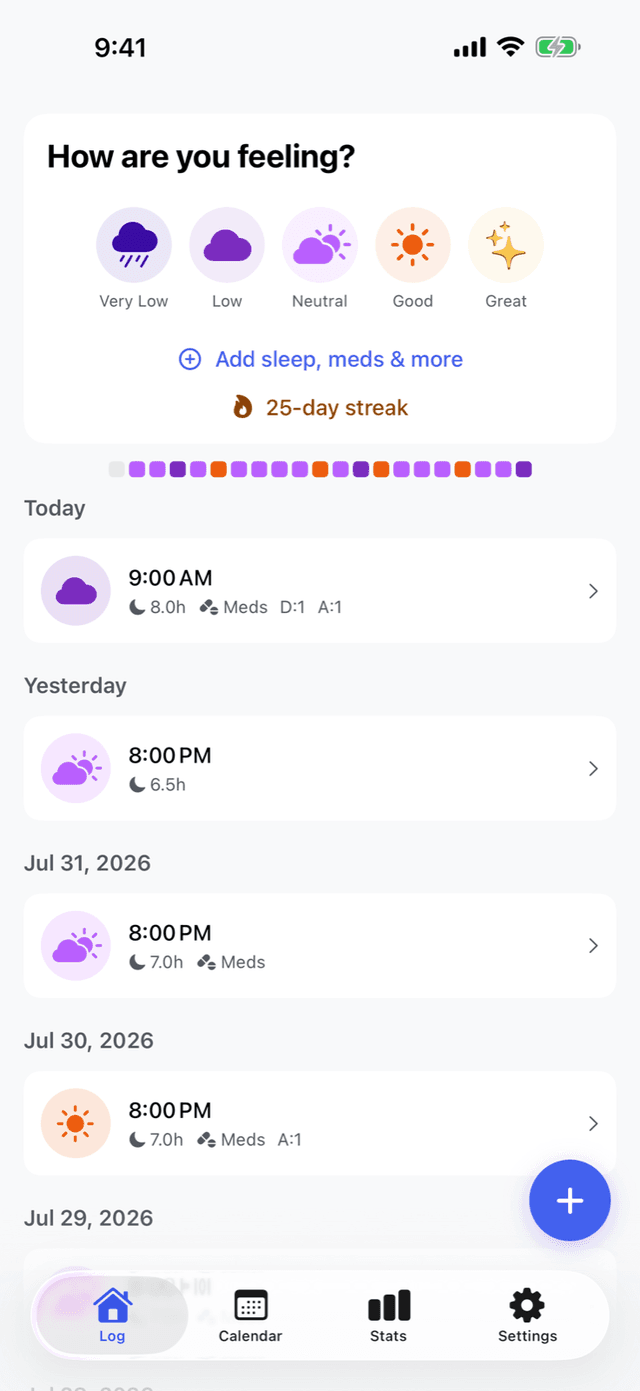
Most days you just need to log how you feel and move on. Some days you want the detail your clinician asks for. MoodSync gives you both, in one entry.
How the scale works
The required field on every entry is a 1–5 mood. One tap. Save. Done.
Since version 2.0, that tap does not even need your phone. The Apple Watch app logs a 1–5 mood from your wrist — which counts on the days, mid-episode or mid-meeting, when pulling out your phone is one step too many.
If you want more than that, expand Details and add separate 0–3 scales for depression, elevation, irritability, and anxiety. They start collapsed, so the daily flow stays under five seconds — but they are right there when you want them.
Why two layers?
The one-tap mood is for sustaining the habit. Brief measures get filled in; long ones get abandoned2001.
The 0–3 clinical scales are for the days that matter. They borrow from the compact ordinal tradition of the major psychiatric screeners — HAM-D1960, YMRS1978, ASRM1997, GAD-72006 — which use 0–3 or 0–4 anchors per item, not 1–10 sliders. A small range forces you to commit. Was today a 1 or a 2? You decide once and move on.
What each clinical scale captures
- Depression — low mood, slowed thinking, loss of interest, low energy
- Elevation — euphoria, drive, racing thoughts, expansiveness
- Irritability — anger, hostility, sensitivity to interruption
- Anxiety — worry, somatic tension, restlessness
Log all four on days when you want detail, or just the one or two that matter today.
What this is for
Visit prep, mostly. Scrolling back through four weeks of mood pills and the days you added clinical detail gives your clinician something specific to anchor the conversation on — instead of "it's been an OK month, I think."
More on the scales
Sources
- Hamilton M (1960). A rating scale for depression, Journal of Neurology, Neurosurgery, and Psychiatry. link
- Young RC, Biggs JT, Ziegler VE, Meyer DA (1978). A rating scale for mania: reliability, validity and sensitivity, British Journal of Psychiatry. link
- Altman EG, Hedeker D, Peterson JL, Davis JM (1997). The Altman Self-Rating Mania Scale, Biological Psychiatry. link
- Spitzer RL, Kroenke K, Williams JB, Löwe B (2006). A brief measure for assessing generalized anxiety disorder: the GAD-7, Archives of Internal Medicine. link
- Kroenke K, Spitzer RL, Williams JB (2001). The PHQ-9: validity of a brief depression severity measure, Journal of General Internal Medicine. link